The moving boxes are barely unpacked when the next delivery arrives: furniture, a small appliance, the week's shopping. A home fills up, and some of what comes through the door immediately needs a way out. Gardens and terraces feature heavily in the imagined life in Mauritius. The space for empty bottles, packaging and a broken fan gets rather less attention.
Yet that space matters. A usable kitchen corner, a clear route to the gate and an arrangement for bulky objects can make daily life easier. Household waste collection in Mauritius becomes a very local subject when viewed from one front door.
Making space in the kitchen
An empty jar and the remains of dinner do not necessarily have the same destination. Nor do an appliance and the cardboard it arrived in. Putting everything under the heading of “rubbish” makes tidying quicker for a moment, but leaves the next part unresolved.
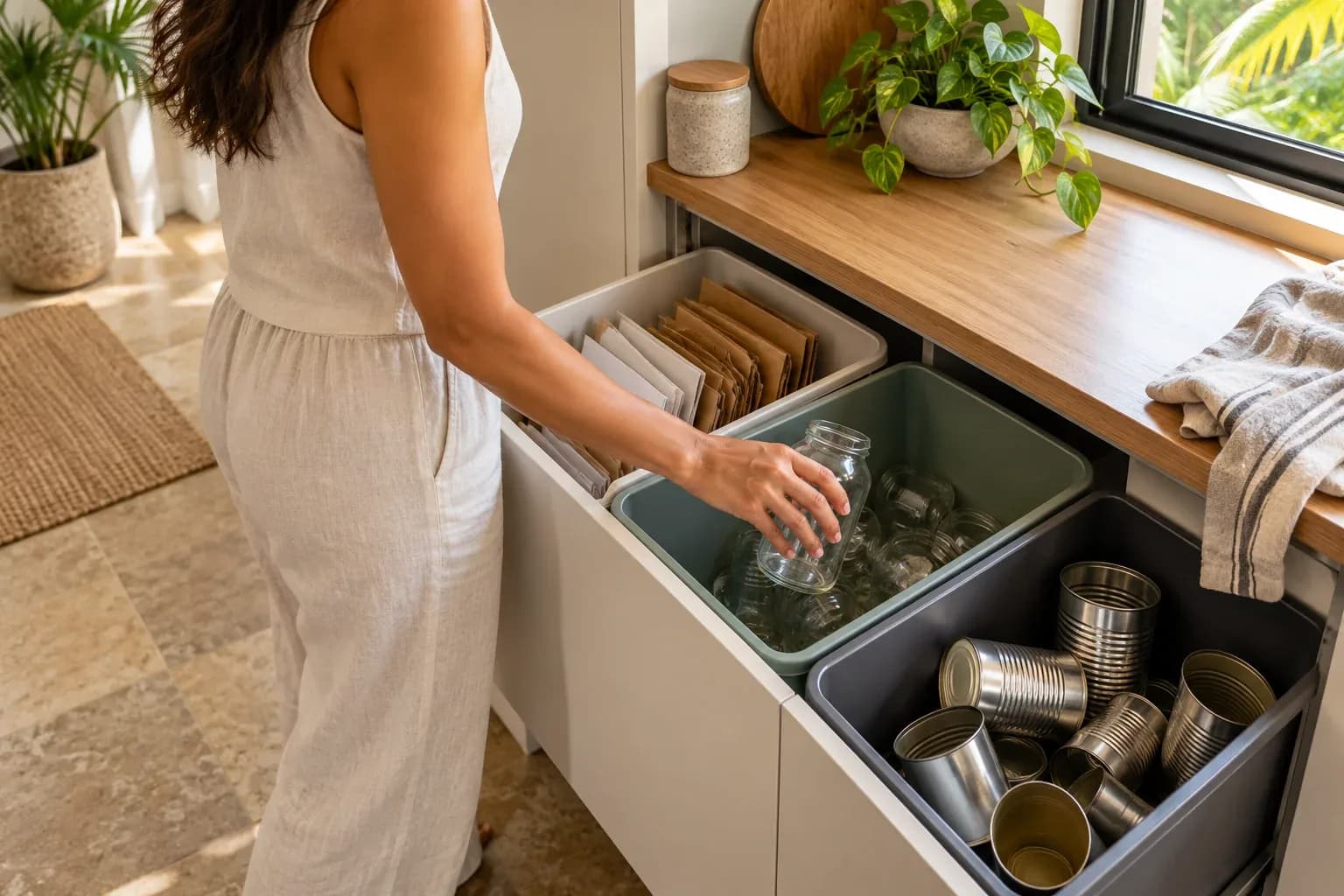
A sorting arrangement can be modest: accessible containers, somewhere for paper and cardboard, and a small holding space for objects whose destination is still unclear. The kitchen need not look like a recycling depot. The arrangement simply needs to work when someone is tired, preparing food or unfamiliar with the household routine.
Packaging symbols can seem reassuringly definite. They do not establish whether a local collection point accepts the material. Instructions from the particular operator matter. A bottle, a tray and a composite wrapper may look similar in a container while needing different treatment.
The position of the bins matters as much as the cupboard around them. If you have to move a stool or clear a shelf each time you open the door, it may be worth finding another spot.
The journey beyond the gate
The municipal or district council can tell you when rubbish is collected and where to leave it. In an apartment building, the property manager is a useful first contact. Ask what the collection takes, too, before leaving anything beside the bins.
In an apartment building, that part of domestic life may take place in a shared refuse room. In a house, the route to the collection point is more visible. Can a container come out without moving the car? Is the path clear? Does the arrangement also work for the person who cleans or looks after the property?
These details are easy to miss during a viewing. They belong to comfort just as much as a well-placed cupboard. Something that looks discreet in a photograph may become inconvenient if every bag has to travel through the whole house.
For recyclable materials, the Observatoire identifies Civic Amenity Centres at La Chaumière, La Laura and Poudre d’Or. Call before loading the car to check whether the centre takes your items and how to drop them off.
The things that do not fit
A replaced chair, an appliance that no longer works and leftover paint can occupy a garage corner for months. Their size or nature calls for something other than the usual collection.
A retailer's take-back arrangement or a removal service may be worth exploring where available. Ask where the items will go. For an unfamiliar chemical or product, get disposal advice before pouring it into another container or mixing it with anything.
At home, the arrangement becomes useful when everybody knows what follows sorting. A few clear labels are better than a row of containers whose purpose nobody understands. If cardboard overflows every week, the storage space or frequency of trips may need changing.
When ordering the next large item, ask whether the seller can take away the old one. It is easier to arrange before the replacement arrives.