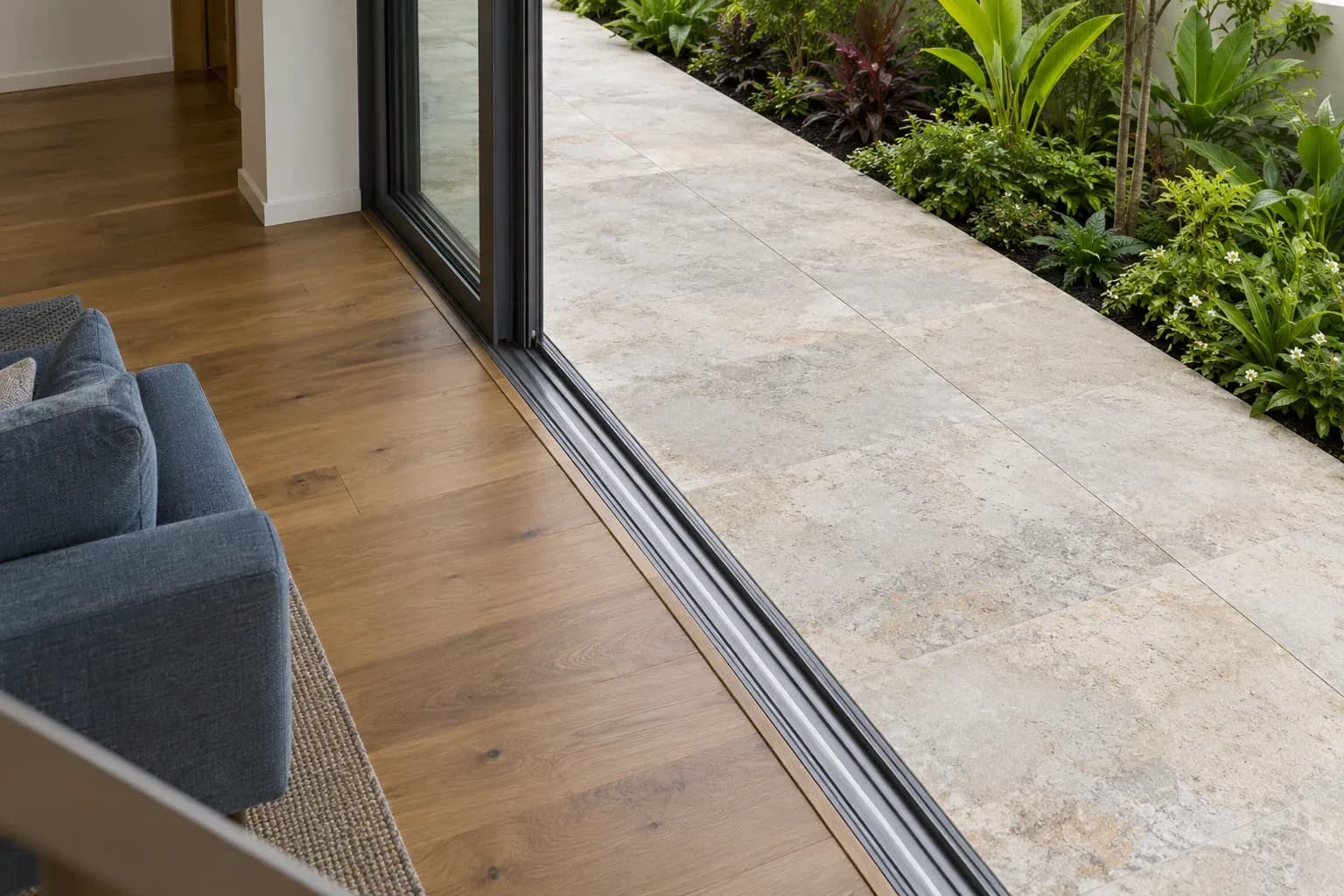
The terrace lies beyond the living room, on the other side of the glass doors. On a sales plan, it also has another place: a line in the area schedule. That small addition can shape an early comparison between two apartments in Mauritius.
A total catches the eye and is easy to remember. Its component lines say more about the home: enclosed rooms, walls counted with them, a terrace, sometimes even a garden. To understand a price per square metre, you need to follow those figures through to the area used in the division.
The 17 square metres beyond the living room
On its presentation page for The Essence in Trou aux Biches, developer 2Futures publishes an area schedule for a one-bedroom apartment on the first floor of blocks A and B. It shows 72 m² of interior space, including walls, followed by a 17 m² terrace. The stated total is 89 m².
These three figures describe the same plan. Remembering only 89 m² loses the breakdown. Remembering 72 m² without “including walls” loses something else: this is not simply the clear floor space available for furniture.
Another schedule, for a two-bedroom ground-floor apartment, takes the distinction further. Its total of 198 m² comprises 119 m² of interior space including walls, a 25 m² terrace, a 6 m² yard and a 48 m² private garden. These are the developer’s published categories; reading them does not confirm that an apartment is available or that its dimensions have been checked on site.
Walls still count
Subtracting a terrace from a total does not necessarily produce an area comparable with another listing. You still need to know where the measurement boundary runs and what remains within it.
The international standard IPMS: All Buildings illustrates this through two ways of measuring selected spaces. IPMS 4.1 includes the floor area occupied by walls and columns; IPMS 4.2 subtracts it. Both have precise definitions. They are different measurement bases, not competing estimates of a home’s value.
The standard also calls for the measurement method and date to be recorded, along with whether and how measurements were verified on site. These details help explain a result. They do not mean that every Mauritian listing uses IPMS, or that the standard imposes a sales convention in Mauritius.
A schedule tied to the correct plan is therefore more useful than an isolated number. A professional can explain what has been included rather than leave a buyer to reconstruct the areas from a small image.
One asking price, two ratios
Take an entirely fictional example, unrelated to prices at The Essence: an apartment offered at 13 million rupees, with 100 m² of interior space and a 30 m² terrace. Dividing the price by 100 gives 130,000 rupees per interior square metre. Dividing it by 130 gives 100,000 rupees per square metre including the terrace.
The asking price has not changed. Only the area used to divide it has changed. This calculation assigns no particular value to the terrace and provides no weighting to apply across the market.
The terrace may, of course, be exactly what appeals about the apartment. Showing it separately gives it its own place: an outdoor space you choose, with dimensions of its own. The schedule helps explain what is being compared before the conversation turns to what you are willing to pay.